28 December 2015

Can't run Bioshock on windows 7/8/10? This is the fix

Hello there readers,and welcome to my blog. It's Christmas time and it's also the times for the glorious steam winter sale ( thank you Lord Gaben). Scrolling through the great deals on steam and suddenly you find bioshock triple pack for dirt cheap. Without thinking too much, you grab the bundle and get ready for non-stop bioshock trilogy play.

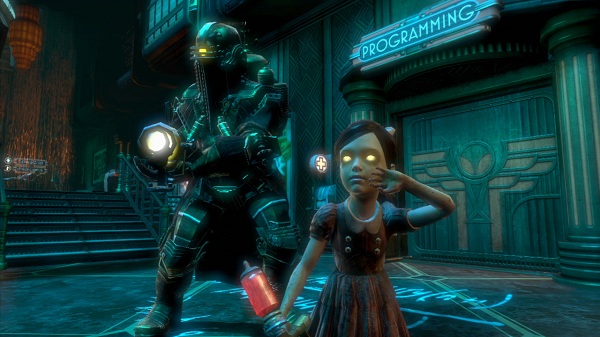
Ahh little sister

Then come the part when you try to run Bioshock. Instead of the game, you are greeted by an error message (0x00003 error or some sort) preventing you from playing your beloved game. Fear not because i will tell you how to fix this.

1. Try to run the games as admin.

2. Run the game for compability mod for windows vista sp2 (or older). You need to test it yourself because it varies for every person

You also may encounter no sound glitch. You may encounter this if you have realtek onboard sound card. To fix this, simply ;

1. Open control panel, click "Hardware and Sound", click "Sound", click "recording" tab; then right click in the middle of the window where the devices are and tick "show disconnected devices". This will bring up Stereo Mix for you to enable and Bioshock/Windows 7/8/10 sound problems gone.

2. If the method above doesn't help you simply plug in the microphone (somehow plugging in microphone automatically activate stereo mix)

If the above methods work for you guys dont forget to tell me in the comment section below. That's all from me and happy gaming.


5 February 2015

Call of Duty: Advanced Warfare

Hello there this is Accel and welcome to my review of Call of Duty : Advance Warfare. This is the latest installment of this series. This game is developed by Sledgehammer Games for ps4/xbone/pc while for the ps3/xbox360 version is being developed by High Moon Studios and published by Activision. This game was released on November 4 worldwide on all platform except for the Day Zero edition whivh been released a day earlier.

Game link : www.callofduty.com/advancedwarfare
Steam link : http://store.steampowered.com/app/209650/


With Advanced Warfare, Activision is taking the extremely successful Call of Duty mostly to places it’s already been, which is to say this is a game about war, shooting, explosions and guns. But it’s also taking a stab at some realistic futurism with the ‘ Exo ’ suits your character gets to wear, which augment your ability to navigate your environment and deal damage to your enemies, and weapons that boast some plausible improvements over their counterparts of today. And of course, Kevin Spacey is all over the place.

Here’s a disclaimer up front: I don’t usually spend that much time playing these kinds of games. My interests favor old weapon, some world war II  action and Captain Price. That said, I also cut my teeth on classics like Halo for the PC, the Killzone games and Ghost Recon games. Still, I’m coming to Call of Duty: Advanced Warfare with only a casual knowledge of the games in the series that precede it.

That said, I thoroughly enjoyed Call of Duty: Advanced Warfare’s single player campaign. It struck a good balance between exposition, basic instruction and making sure you get to the action right away at the beginning, jumping you right in at the start and only then peeling back for the traditional “oh here’s some training simulation” to refine the basics you pick up in the initial live combat opening level.

What surprised me about Advanced Warfare most might’ve been how much I enjoyed its story. The plot, while both predictable and shallow, was nonetheless solidly put together, well-told and well-acted by both the animated characters (which look fantastic on the PlayStation 4, by the way) and the voice actors behind them, which include Spacey in a key role that’s probably really best described as the lead, given his screen time, Troy Baker as the player character Jack Mitchell, and Gideon Emery as the creatively-named “Gideon.”

While the story isn’t going to blow anyone away, even with its big ‘twist’ (which you should be able to see coming from basically the opening cutscene) it’s sort of like any good big budget action movie, in that it’s a simple story, well-told, with a focus on action and special effects that makes up for the lack of a deep narrative. Again, I’m not the most familiar with this series, but as far as action games go, this is one of the better recent entrants from a story perspective.

Exo skeleton Yeah 

On the gameplay side, Call Of Duty delivers typically solid first-person shooter action. The fundamentals are all well done, as is the new arsenal of weaponry. Each gun can be found throughout the game outfitted with a number of different sights and scopes, and you’ll find pretty quickly that you’ll likely prefer one type over another. Tracking down the right weapon variant for your play style adds to the experience, and I quickly found I’d become either frustrated when I couldn’t find a weapon with a threat indicator, or feel a wave of relief wash over me when I could.

As for the Exos, the exoskeleton augmentation suits that soldiers wear in Call Of Duty: Advanced Warfare, they do indeed offer fun gameplay tweaks, including the ability to jump much farther than you can normally in games like this, a hover break for steep descents, grappling hooks for zipping around maps and quietly taking down bad guys, and much more. Each mission has a different loadout, and pretty rigorously guides and limits your use of these new features, but in multiplayer it’s up to you to determine what powers you carry, and how you use them.

Multiplayer is a part of Call of Duty that is markedly improved in this generation, in part because the Exo’s really open up the game for the kind of fun that the series’ ultra-realistic approach just couldn’t offer, as opposed to something like what Titanfall or the Halo series provides. The Exo’s abilities make it easier for new players to run away when they need to, and the Combat Readiness Program that lets new users slowly immerse themselves in multiplayer without verbal assaults or even a stable identity to be ashamed of is a terrific touch.

Of course, I still suck at Call of Duty: Advanced Warfare multiplayer, and I’m easy fodder for more experienced players in standard games. The inclusion of the excellent co-op assault mode makes for terrific local cooperative multiplayer experiences, however, and I’m old school enough that this more than makes up for an online multiplayer component that’s still dominated by the most dedicated, mostly obnoxious hardcore players.

In short, Call Of Duty: Advanced Warfare is a reboot of sorts for the series, and that proved enough of a hook to get me back into the franchise, whereas previously I had been frustrated by Ghost and Black Ops II. Too often, studios can rest on their laurels with a successful series, but Activision has done a lot more than that here, and the result is a great game. For all of that great reason I will give this game a score 8.5 out of 10. Definitely worlth trying.

15 August 2014

Sniper Elite III Review

Helo therei'm Accel and this is my review of Sniper Elite III. I couldn't write for the past month because I been really busy with school work lately and I'm really sorry. By the way, The title alone gave me reason to joyously dive into the action. No matter the shooter combat game I’ve enjoyed over the years, be it “Gears of War” to “Call of Duty,” the Holy Grail has always been discovering a coveted sniper rifle and Sniper Elite III is a great games for me. Sniper Elite III is a game where you shoot people silently and some how there a cameraman with slowmotion x-ray cam showing the shot if you hit somewhere nasty.

Game Link: http://www.sniperelite3.com/
Steam link: http://store.steampowered.com/app/238090/


What comes to mind when you think of Rommel and Monty’s monumental tussle for the Maghreb? Possibly not narrow canyons strewn with tank wrecks, Petra-like cliff temples, medieval castles swarming with Axis soldiers, and secret weapons factories carved into mountains. Rebellion’s level architects and texture artists know a thing or two about creating atmosphere and encouraging tactical experimentation, but chop down the date palms, chip off the pretty zellige tiles, and still the gust-driven dust flurries and the levels could be set just about anywhere. For most of the 11 or so hours it took me to sneak, stab, snipe and Welrod my way through the eight mission single-player campaign, I was waiting for The Desert Mission, the op that would send me out onto the dunes and the rocky plains… abandon me in the Qattara Depression to brave sandstorms and shoot at mirages. I still can’t quite believe that mission never materialised.

Objectives tend to be as genre-endebted as the environments. When the Top Brass want an enemy sharpshooter eliminated, mine-laying party discouraged, or convoy observed, they call on one of your off-screen understudies. You’re the square-jawed, stubble-scalped Afrika Korps bogeyman summoned when they need a heaving hornets’ nest infiltrated, some blueprints stolen, prisoners freed, bigwigs assassinated, or thermite placed.

Before all this you have to locate your targets first. Your binoculars allow you to 'tag' your enemies so you don't lose track of them, but rather than simply placing a small marker on your screen or map, you're instead shown their full silhouette at all times, even as they then move away and obscure themselves behind layers of walls, foliage and other scenery.

It goes without saying that a little artistic licence is being used here for the sake of fun - not even the greatest snipers in the world have Superman's x-ray vision - so it's best just to roll with it.

After all, it may not be authentic, but it does make for more entertaining gameplay. Take your time to spot as many upcoming enemies as you can and your reward is a number of silhouettes wandering around on your screen, blissfully unaware you're now planning a course of attack.

However, that's not to say they're without fault. Sniping is about as satisfying as it gets, and the slow-motion bulletcam (complete with disturbingly detailed x-rays of the enemy's insides bursting, breaking and shattering) is gruesome but gratifying in a B-movie kind of way, as you can see by this picture.

gruesome
 But sometimes you can be certain you've got a direct hit (playing on the standard Marksman difficulty brings up a red dot showing where your bullet will hit) and you'll miss, causing the enemy to react to your gunshot and your hiding position to be compromised.

This can also occasionally happen in close quarters with your handgun - understandable given that nobody's a perfect shot, but frustrating when the bewildering lack of a melee attacks means your best course of action is to run off and hide, hoping you don't get shot in the back in the process.

Sadly, the AI - something Rebellion pinpointed as a major area it wanted to improve - still leaves a lot to be desired at times. It can be remarkable how close you can get to an enemy without him spotting you, and when he does it takes a while for him to engage.

Of the 18 or so hours I’ve spent with Sniper Elite 3 thus far, roughly a third has been spent in the company of sentient snipers. In addition to the solo attractions – the campaign and wave-survival challenge modes – there’s a pair of co-op missions and a slim yet effective selection of adversarial multiplayer game types. In ‘No Crossing’ the purest and most static of the MP styles, two teams trade cagey killshots across impassible gullies. With no danger of getting flanked or shot in the back of the head by infuriating insurgents, play basically boils to choosing a promising spot, then watching and waiting…

Sniper Elite III is not without its flaws, but these are outnumbered by the sheer satisfaction it provides when everything works as it should. The sniping feels right, the slow-mo kills are disgustingly moreish and each combat area is large and diverse enough to encourage multiple playthroughs with different methods of approach.

The Sniper Elite series has never threatened to topple the Battlefields or Call Of Duties of this world, and this third entry never really comes close to changing that. But for those looking for a less gung-ho, more methodical approach to a war game, then ropey AI aside you could do a lot worse than this.For me, I think this game deserve 7 out of 10


23 May 2014

Counter-Strike Creator Minh Le Confirms The Existence Of Half-Life 3 And Left 4 Dead 3


Minh ‘Gooseman’ Le, one of the co-creators of the original Counter-Strike, has let slip that both Half-Life 3 and Left 4 Dead 3 are in development.

Speaking in an interview live on Twitch TV, Le confirmed what everyone has been hoping for, that both Half-Life 3 and Left 4 Dead 3 are being worked on by Valve and he has personally seen the new Left 4 Dead in action…


crimsonheadGCN over on NeoGAF spotted the interview earlier today, in which Le says he’s seen some concept art of now-almost-mythical Half-Life 3.

"I think it's kinda public knowledge, that people know that it is being worked on,” said Le. “And so if I were to say that yeah, I've seen some images, like some concept art of it, that wouldn't be big news to be honest. But yeah, I mean like I guess I could say that I did see something that looked kinda like in the Half-Life universe. And I mean it wouldn't surprise anyone if I said they're doing it, they're working on it, yeah. So to go on a limb I'd say I did see some concept art for Half-Life 3."

No doubt Valve's trained team of assassins are hunting him down as we speak, but Le was keen to also to point out the existence of Left 4 Dead 3 which, up until now, Valve has neither confirmed nor denied.

"You know, the one thing I'm really excited about is Left 4 Dead, the new Left 4 Dead. I saw it, it looks great. I was really excited when I saw that, I was like "wow, this looks great". Cos I really enjoyed Left 4 Dead, it was just one of those games that really just changed the industry. I think at the time there wasn't many good co-op games, so yeah, this is a great co-op game."

There’s hope then for those still optimistic that Valve is working on an eventual Left 4 Dead 3 and Half-Life 3, although if Gooseman’s info is correct then it sounds like both projects may still be some way off.

When do you think this pair of highly-anticipated titles will finally see the light of day?

Which of these two heavyweights are you looking forward to most?

Let me know!

21 May 2014

Space Hulk Gets New Co-Op Mode And Five Mission DLC


Good news for fans of Full Control’s Space Hulk; the Danish development studio has announced today that the title now has co-op mode.

In addition to the new game mode, the latest free patch contains a number of bug fixes and updates. It coincides with the release of a new campaign for the game - “Harbinger of Torment”...

Thomas Hentschel Lund, CEO of Full Control, spoke of the studios excitement regarding the game’s new co-op mode. “It’s been in development for several months now, as we made a complete overhaul of the multiplayer mode to make it a seamless experience so players can easily jump into a co-op game. In honor of launching co-op we are also releasing a new five-mission campaign, ‘Harbinger of Torment’, that is now available to Windows, Mac and Linux players”.

The Harbinger of Torment DLC is designed to tie in with the new cooperative mode, and is specifically designed for 4 player co-op on PC, Mac and Linux. Full Control said the following about the new mission. “As the Space Hulk, the Harbinger of Torment, emerged from the warp it was discovered to be on a collision course with the planet Baal. Several attempts were made to change course, but all failed. A team of the Imperium’s finest warriors is sent to the Harbinger of Torment to try and reverse the engines or stop them altogether. Failure is not an option.”

The Harbinger of Torment campaign contains five missions based on Games Workshop's original Space Hulk story arc, and will be available for $4.99/€4.99/£3.99.

Space Hulk originally hit PC back in 2013. Set in the Warhammer 40,000 universe and based on the best-selling board game of the same name, Space Hulk is a 3D turn based strategy set in a lost and ancient space vessel infested with predatory alien Genestealers.

Are you a Space Hulk fan? What do you think to the addition of a co-op mode and extra co-op missions?

Tell me what you think.

20 May 2014

CryTek Developer Warns PS4 And Xbox One Facing Huge RAM Limitations


Ryse: Son of Rome developer CryTek has warned that being limited to 8GB of RAM will be a huge shortcoming for both the Xbox One and PlayStation 4.

Both current-gen consoles come packing 8 gigs of memory, a huge chunk of which is taken up by each system’s OS. While many of the early titles have looked fantastic, CryTek’s business development manager Sean Tracy has said that it is already encountering RAM limitations on PS4 and Xbox One…


Speaking in an interview with GamingBolt, Tracy claimed that “Though the PS4 and Xbox One don’t offer an enormous jump over the previous generation in terms of raw processing power, the custom AMD APU’s within both platforms represent a huge leap forward in terms of integration and capability.

“We are delighted with the updates to the next-gen hardware but of course always want more! The unified architecture of the [Accelerated Processing Units] allows us to easily leverage massive amounts of resources for all kinds of features including rendering, physics, animation and more.”

While this may all sound like great news for console gamers, Tracy was quick to put the kibosh on this news, signalling alarm when revealing that Xbox One launch title Ryse: Son of Rome pushed the system to its limit thanks to RAM limitations.

“I would have to agree with the viewpoint that 8 gigs can easily be filled up, but also keep in mind that developers don’t necessarily even have access to all 8 gigs of it,” Tracy continued. “For example the Xbox One retains some of the RAM for OS purposes.

“We already had to manage quite intensely our memory usage throughout Ryse and this will be one of the limiting factors surely in this generation. As hardware gets stronger the complexity of scenes can be increased and the dynamism within them. However, with that said it’s not the raw power alone that will allow for photorealistic graphics but technology that intelligently scales and utilizes all that the hardware has to offer.”

It’s worth bearing in mind that the Xbox 360 and PlayStation 3 both came packing a meagre 512MB of RAM, which was still enough to produce gaming beauties such as The Last of Us, Grand Theft Auto V, and Halo 4.

Do you think this console generation will age quicker than any before it?

The Xbox 360 took a whopping 8 years to be succeeded by the Xbox One, how quickly do you think Sony and Microsoft will come back with new consoles?

Let me know!

12 May 2014

Five Games Releasing In May To Play On Integrated Graphics


Have you played Daylight with any integrated graphics GFX solutions? How is it running for you? Let me know in the comments!

The Incredible Adventures Of Van Helsing II

If you love a bit of good, old fashioned, monster-clicking ARPG fun, chances are you may have played the first outing of The Incredible Adventures Of Van Helsing when it launched last May. Now round two is about to hit PC, and like its predecessor, it fully supports integrated graphics. It specifies Intel HD 4000 as minimum, but if the game is as well optimised as its predecessor (which ran on Intel HD 3000 smoothly on low settings) those with lower-end rigs should find this game more than playable. Check out my beta preview impressions for more information on The Incredible Adventures Of Van Helsing.

Tropico 5

El Presidente is back for a fifth instalment of island-sim Tropico, and the Kalypso Media title is easy on the graphics. Tropico 5 - which allows players to travel through time and watch your island develop from the 19th century to the near future - has Intel HD 4000 listed as minimum requirements, so this or anything more powerful should run. Depending on Tropico 5's optimisation, it should be able to run pretty decently on laptop versions of this GFX with lower settings, too.

Transistor

Supergiant’s 2011 Bastion is arguably one of the greatest indie ARPGs ever made, combining beautiful visuals and mindblowing soundtrack with brilliantly fun gameplay. The California-based studio is just about to release its second title - Transistor - and the great news is that the game should happily run on integrated graphics. It specifies Intel HD 3000 as minimum, so anyone with this solution or better should be able to dive in to the enchanting world of Red and her time-bending sword come May 21st.

Dynasty Warriors 8: Xtreme Legends Complete Edition

Dynasty Warriors 8: Xtreme Legends Complete Edition packs a vast amount of new content in for its release this May, and the latest iteration of the long-running action series is easy on the system, too. Although - unlike the other titles on this list - it doesn't specify Intel graphics requirements, the minimum settings ask for a GeForce 8600 GT, over which Intel HD 4000 graphics should have a slight edge assuming the rest of your rig is up to task.

Of course, there's always a whole host of indie games around that will run on lower settings. My personal indie hype for the month is Always Sometimes Monsters, a little 8-bit open world that I've had my eye on for a while.

Which games are you most hyped for this month? What will you be playing on integrated graphics in May?

Tell me your thoughts in the discussion area.

Final Fantasy III Finally Arriving On PC With Improved 3D Visuals


Final Fantasy III has been given a fresh lick of paint in anticipation of an imminent PC release, Square Enix has revealed.


The 1990 JRPG classic makes its way to PC for the first time ever having shifted more than 2 million copies worldwide, this time with a 3D makeover reminiscent of the 2007 DS remake…

Final Fantasy III has been given a fully 3D makeover for its PC release.
Along with improved 3D visuals, the Final Fantasy 3 PC edition comes packing additional story sequences and visual effects for its Job Mastery cards. FFIII is coming exclusively to Steam for now, and of course comes packing the usual Steam trading cards and achievements.

For those unfamiliar with Final Fantasy III, this third instalment centres around the quest of four orphaned youths tasked with restoring balance to the world. The quartet of young warriors must hunt down the four dark elemental crystals in a lengthy quest, and features the usual turn-based combat antics and randomised battles synonymous with early Final Fantasy titles.

There’s no release date to speak of as yet but the store page is already up on Steam ahead of its official release.

Looking forward to taking a peek back at the early days of the Final Fantasy series?

Do you think these recent releases suggest an effort on Square Enix’s part to bring the entire Final Fantasy series over to PC?

Let me know!

26 April 2014

Unreal Engine 4 Support Arrives For Linux, Steam OS, PS4 And Xbox One

Epic’s Unreal Engine 4 is now compatible with Linux, Steam OS, PS4 and Xbox One after a major update to the graphics engine.


We all saw the battle of the game engines, as Epic, Crytek and Unity fought over their respective game engines, offering up knock-down prices for subscription services that look hard to resist. The competition’s far from over though, as Epic has now future-proofed its brand-new engine for the latest gaming consoles, as well as doing Gabe Newell a hefty favour with Linux and Steam OS support…

Unreal Engine 4 is available now to would-be developer for a $19 per month subscription fee. The days of devs forking out millions of dollars to license game engines now seem but a hazy memory.

I know from the tech demos that I’ve seen over the years that UE4 is a bit of a beast, but until now there’s nothing out there actually released to support it. Next week’s procedurally generated horror Daylight has become the engine’s debut, bucking Epic’s trend of showcasing its latest and greatest engine with its latest and greatest game. Epic is course busy beavering away on Fortnite, a co-op sandbox survival game where players must work together to erect a fort by day, before fending off invaders at 'nite'.

So what does this mean for you, the gamer? Well, more games. Games galore. A games extravaganza on nearly every platform. The steamrolling Linux support could well see a huge shift in gaming as the years roll by, but for now it’s looking like Steam OS could be getting a strong start when it officially launches later this year.

Unreal Engine 3 was undoubtedly the stand-out engine of the previous generation of videogames, do you think its successor will stand up tall in the next round of games?Let me know!

21 April 2014

Scourge: Outbreak Review

Hello there,I'm Accel and this is my review on Scourge: Outbreak.Among my ever-changing taste in gaming genres, the shooter has always been one of my favorites. From the arena shooter like Quake III to the action-adventure-filled shoes of Nathan Drake in Uncharted, it’s hard for me to find one I don’t like. When Scourge: Outbreak was thrust upon the shooting community, promising co-op, online multiplayer and a story-filled campaign, many, including myself, were highly intrigued. Despite the promises and my excitement, I had a bit of doubt. Instead of pondering on that doubt, I decided to jump in with my fingers crossed in hope of surprises.

Game link: http://www.scourgeoutbreak.com/
Steam link:http://store.steampowered.com/app/227560/


Newcomers to Scourge: Outbreak will find a classically styled, old-school third person shooter, reminiscent of the original Lara Croft and early Gears of War games. Containing a linear and at times somewhat predictable storyline, players will be guided through a futuristic research facility, on a mission to uncover a dangerous secret, kept from the world by the Nogari Corporation.

Tragnarion has worked hard to revive the 4 player co-operative campaign, allowing players to assume the role of one of Echo Squads 4 playable characters, to fight alongside friends or other online players. By providing each of the squad members with their own unique stats and abilities, specialising them towards certain weapons and group positions, players are presented with a variety of play styles and group dynamics. In addition, by playing through the campaign as each separate member of Echo Squad, players will discover new segments of the story through memories and visions unique to that character, increasing the replay ability of the game.


Scourge: Outbreak follows Echo Squad, a group of four stereotypical mercenaries, on their mission to take down the dastardly Nogari Corporation. Echo Squad will go about doing that by rescuing a double-agent, Dr. Reisbeck, and stealing a meteorite fragment that lead to the development of “ambrosia.” Ambrosia is a new “powerful synthetic energy source” which has lead the Nogari Corporation to power, and is responsible for powering Echo Squad’s suits.

 There’s also the rogue Alpha Squad that gets in the way of your mission that must be dealt with. And that’s about all of the information you get regarding your mission in Scourge: Outbreak. Reisbeck, who communicates with you via com chat, attempts to explain further on the origins of Nogari, ambrosia, and Alpha Squad, but the dialogue of these bits of conversation are so uninteresting and boring that it’s hard to muster up the will to even attempt to grasp the point that’s trying to be given. Even when Reisbeck is informing Echo Squad of their current objective, I failed to hold interest because I was never given a reason to remotely care about the one-dimensional mercenaries and the impact their mission actually held.

The playable Echo Squad consists of the mercenaries Shade, Stonewall, Mass and Amp. Just judging by the names, one can assume what stereotype the character is going to hold. Shade is the stealthy assassin-esque character; Mass is the big bouldering brute from Europe; Stonewall is the stone-faced American marine, and Amp is the strong female with a sense of amnesia, leaving her past a complete mystery. Despite Scourge: Outbreak falling prey to these stereotypes, something I found intriguing was the unique stats, leveling up and suit abilities each character sported, even if they did seem to be ripped from the Mass Effect series.


The Scourge: Outbreak also boasts a back to basics online multiplayer, covering 3 game modes; Deathmatch, Team Death Match, and Capture the Flag. These modes are played across 5 maps each of which are found within the campaign and have been adapted for multiplayer combat. What makes the Scourge: Outbreak multiplayer experience different to other multiplayer shooters, is the bareness of the modes and maps. Whilst fighting against other players online, there are no gimmicks, intractable traps, or game changing perks. Player’s battle against one another using their pre-selected weapons, and the available cover found around the map, and the most skilful player comes out on top.

Unfortunately for Tragnarion, the multiplayer servers have been pretty empty since its release on STEAM earlier on this week. Even with the game being made fully cross-platform, allowing PC and Mac players to fight together, players are still having to wait in lobbies for 10-15 minutes before finding enough players to start a match.

This game may not contain next-gen graphics, or have the most original storyline; however Tragnarion have made a good attempt at recreating the classic shooter, and for a budget price what more can you expect and due to that I’d give The Scourge:Outbreak 7 out of 10.So what do you guys think, let me know in the comment section below


20 April 2014

Lucky Number 7 - Playstation 4 Hits New Sales Landmark

The Playstation 4 is an unstoppable juggernaut right now, and it doesn’t appear it’s running out of gas any time soon, as Sony has just announced that its 5-month-old console has already shifted more than 7 million units.

For a point of reference, Playstation 2 was the best-selling console of all time, totalling more than 155 million sales, but shifted just 3 million units during its first 5 months on sale…


It puts the Playstation 4 firmly ahead in the console race for now, easily outstripping the Wii U’s lifetime sales and surpassing the latest known figure of 3.9m Xbox Ones. This figure was released at the end of January, and we’re expecting Microsoft to promote some sky high figures of their own soon, following the launch of Titanfall.

Sony also announced that, as of April 6, 20.5m PS4 games have been sold both digitally and in-store, averaging around three games per person.

“The response from the global gaming community for PS4 has been overwhelming and we are truly humbled that gamers are selecting PS4 as their next generation console of choice,” SCE president and CEO Andrew House said.

In terms of AAA-exclusives the Playstation 4 is looking a bit thin on the ground for 2014, but that doesn’t appear to be deterring games for now. We know we can expect DriveClub and The Order 1886 over the coming months, but beyond that Sony is looking to rely on the indie initiative which has been such a success so far.

The success of the PS4 shows no signs of slowing, do you think this is just a rush from the hardcore early adopters or will it have lasting appeal?

What effect do you think Titanfall will have had on the Xbox One's sales?Let me know!

Hybrid Hard Drives And Whether They Are Worth The Additional Cost

Games are swallowing up storage space like nobody’s business at the moment, with titles such as The Elder Scrolls Online and Titanfall tipping the scales at 60GB plus. With that in mind Solid State Drive (SSD) space is more precious than ever. Despite rapidly falling costs, a 1TB SSD still costs around $500, nearly 10x more than a $55 internal hard drive…


Without scouting out the deals, SSDs can still be expensive business. For many, a substantial SSD is off limits for now, despite the high-speed access and vast performance gains available. We thought it best then to investigate hybrid hard drives, which marry traits from both SSD and HDD components, to see what they offer and whether they’re worthwhile.

The thinking behind a hybrid hard drive is that it combines the high-speed we’ve come to expect from an SSD with the larger capacity and lower price point seen in a traditional hard drive.

What a hybrid HD essentially is is a standard hard drive with a discrete additional SSD capable of housing the OS and the most frequently used data. Most files will be stored on the conventional and more spacious hard drive, while Windows etc will benefit from lightning quick access times of an SSD.

One thing worth bearing in mind for organisational enthusiasts - the hybrid drive is a single unit, both physically and technically when viewed by the PC. A 1TB hybrid hard drive with 10GB SSD will appear as a single 1TB hard drive, with complex algorithms deciding what content is best suited to the limited SSD space.

The caching algorithms take a bit of time to sort itself out as your system calculates what your most frequently used files and programs are, meaning that there will be no performance increase at first. The speed of the hard drive will increase over time as the most accessed files ingratiate themselves into the SSD.

What this means for you, the gamer, is perhaps negligible. Using a hybrid hard drive will mean noticeably faster boot times, as well as faster in-game loading if SSD portion is large enough to house games. It’s worth bearing in mind though that it will pale in comparison to a dedicated SSD, with which you can expect to see ~25% boosts in overall system level performance, compared to ~10-15% with a hybrid drive.

If you’ve got the money to spare then a dedicated SSD is undoubtedly the way to go, particularly when combined with a seperate spacious HDD to hide the legions of files taking up on valuable space on your rig. For those on a tighter budget though, who aren’t particularly bothered by the performance gains seen with a dedicated SSD, then a hybrid hard drive is a great choice above and beyond a traditional HDD.

So what do you think is the best choice for a gamer on a budget?Do you think SSD above all else, are the performance gains too great to ignore?Let me know on the discussion area below

13 April 2014

V-Sync explained


V Sync has been a thorn in many a gamers side for some time now, posing a genuine dilemma to gamers seeking the best in performance.

Unlike many other graphical options, it's not the same as just turning a slider up to max and getting the best, with vsync, screen-tearing and buffering causing problems to even the henchest of rigs. So what is vsync, and is it really as bad as it's sometimes made out to be...

Vsync Explained


So, what is Vsync? It stands for vertical synchronisation, and it’s effectively designed to get your graphics card and monitor working in time together. It should be ensuring they march to the beat of the same drum, rather than your GPU creating frames quicker than your monitor can display them.

Your monitor is always set a specific refresh rate, it doesn’t matter what your PC or GPU is doing at any one time, it will always be outputting the number of images relative to its refresh rate. Monitors refresh rate is measured in Hz (Hertz), which gives you the number of times it is updated every second. So, a 60Hz monitor would be capable of outputting a maximum of 60 frames per second.

It sounds great in theory, but of course it’s not without its caveats of course. Because vsync is tied directly to your monitor’s refresh rate, this puts a theoretical cap on your PC’s performance. Without vysnc enabled, your graphics card could be pumping out more images than your monitor can actually display at any one time, potentially leading to overlapping images - causing the effect known as screen-tearing.

As an example, let’s say you’ve got a 100 Hz monitor, and you’re playing a game that your GPU is outputting at a rock-solid 120 frames per second. Because the monitor is only capable of displaying a maximum of 100 frames in a second, the other twenty are redundant. The problem is that the GPU is still pumping out these images, meaning that during 1 in every 5 frames, two frames will be displayed at the same time.

The effect visually is a disjointed image, with certain points that have moved rapidly during the 1/100 of a second change appearing to have teared due to being created twice in a single frame. It can be anywhere on the screen, and it’s not a screen-wide occurrence, but for many gamers it can pretty off-putting. The more out of sync your monitor and GPU are, the worse the screen-tearing will be.

So that explains why to have Vsync on, but why does it get so much hate? Take the red pill, ladies and gents, because we’re going deeper down the rabbit hole…

Double Buffering

Double buffering was a technique created decision to lessen the effects of screen-tearing. It basically creates and frame buffer and a back buffer - your monitor grabs the image from the frame buffer, while the graphics card copies the next image from the back buffer to the frame buffer, and creates a new image for the back buffer. Think of it like a daisy chain from image creation to image display, ensuring each step is finished before moving onto the next. If the copying isn’t quick enough there can still be torn images, but it’s still an improvement.

The downside though, is that double-buffered vsync can only happen at set values of the refresh rate. For example, on a 120 Hz monitor, double-buffered vsync can output at 120fps, 60 (½ 120), 40 (⅓ 120), 30 (¼ 120), 24 (⅕ 120) etc. Imagine that you’re playing a game and it’s usually hitting about 70 fps on your rig, meaning that double-buffered vsync automatically ensures it outputs at 60 frames per second. If you hit a graphically intense section that drops your fps down to 59, it will automatically drop all the way down to the next available integer, 40 fps. What was a simple and barely noticeable 15% frame rate drop suddenly becomes nearly 50%, creating a massive lurch in frame rates.

To Vsync or not Vsync, that is the question

What you’re looking at with vsync is a choice, a personal preference that comes entirely down to you. For many, switching vsync on will make for a noticeably prettier game, particularly those afflicted few that can spot an image tear from 20 paces, blindfolded. Unfortunately, it’s these very same people that are likely to notice screen-tearing that will notice the framerate hitches when vsync is turned on. While double or even triple-buffering can help greatly reduce this effect, for many the huge percentage hits framerates make it a road not worth travelling.

What it's crucial to remember though, is that no matter how fast your GPU can pump out images, it's always going to be limited by the tech in your monitor. As long as your GPU can create these images faster than your monitor can display them, then you're not going to lose out in any way from vsync limiting your framerate.

So, do you turn on Vsync or would you rather have your GPU working to the limit?Does screen tearing bother you, or can you tell the difference when the framerate drops for that matter?Let me know below!

12 April 2014

Dead Island: Riptide review

Hello there, I'm Accel and this is my review on Dead Island: Riptide.Dead Island: Riptide is more of the same, and if you played and enjoyed the last one then in all likelihood that's all you want to hear from this review.If you put any amount of time into the original then chances are you already know the praise and criticism that's about to follow.That's not to say there aren't changes – improvements even – but Dead Island: Riptide won't appeal to those who were left feeling cold by the original.

Game link: http://deadisland.deepsilver.com/agegate.php
Steam link: http://store.steampowered.com/app/216250/


Still, if all you ever wanted was two games about slicing zombies with poisoned katanas and exploding knives, Riptide has your back.

Like its predeccessor, Dead Island Riptide is light on narrative, but there's the skeleton of a story in place. The original survivors of the Banoi outbreak have been picked up by a stereotypical, self-destructively shady military organization, and are being held hostage on a ship when the zombies rear their ugly heads again. After an altercation on board, the protagonists wash up on a new island, Palanai, which is dealing with its own zombie crisis. Cue the onslaught of back-and-forth missions!

Riptide isn't billing itself as a sequel, which is probably for the best as it truly feels like an expansion upon the original -- to the point where you can even import your old characters and access their old levels and unlocked skills. Each character has access to some expanded skills and will likely be close to maxing out their progress trees by the time the campaign ends. Despite new abilities, none of the existing four characters play noticeably differently and all of them generally fall back into their hacking or bashing ways. There is, however, the inclusion of a new hand-to-hand combat character, who uses kicks and punches with deadly efficiency.

As the story goes, after living through the events of the first game, the survivors (you can import your Dead Island 1 save) are whisked off by copter to an awaiting army ship, where they're immediately greeted with the sight of handcuffs. Despite their protestations, they're soon overpowered and drugged and are sent packing to the on-board laboratory for tests.

When they wake up in their cell, they find they've made a new chum - a former navy soldier imaginatively named John Morgan. Despite some initial hostility they discover that they have more than just a dodgy accent and a terribly hammy script in common.Like the original survivors, John is also immune to the virus that's wrecking havoc around the pacific, and so is eligible to join the cast as Riptide's sole new playable character. A brawler with a killer uppercut and a devastating big boot, John is a good choice for players who like to get stuck in, but he's nothing special, either to look at, listen to or play as.

Anyway, to cut a long, and terrible tutorial level short, the ship crashes into yet another island that's teeming with undead assholes, and our gang have to hop off and kick their heads in all over again, preferably before the US army nukes the place off the face of the Earth, because according to an army general who's also washed up on shore, that's totally going to happen. A shame too, because the wild, lagoon-streaked island of Palanai is quite the tropical paradise - if you can look past the smell of rotting flesh, that is.

Riptide's biggest failing, however, is in its environment. Balai simply isn't as fun a place to explore as Banoi. The original game's tropical resort was a unique and flavorful setting, giving Dead Island its own sense of personality, and splitting off into various interesting town and prison areas. Banoi had an identity, one players could feel intimately familiar with over the course of their adventures. The frequent backtracking was mitigated somewhat by the generally compelling surroundings.

By contrast, Palanai is a wonted expanse of jungle for the most part, full of linear corridors gated by invisible walls, and indistinct scenery. The game's second major area, Henderson, is a little more interesting, bringing back some of the town aesthetic from the original game, but it's not a patch on the variety found there. The map design feels convoluted, full of winding roads and dead-ends that undermine its open-world presentation; there's an overwhelming sense of environmental clutter, especially in areas littered with alleyways that could go anywhere or nowhere, depending on your luck.

It could go without saying that Riptide is not a pretty game. It looks exactly like the original, which was mutton dressed as mutton. On consoles, textures are muddy, screen-tearing is common, and there are several areas where the framerate drags to an unbearable crawl. None of the visual issues are necessarily dealbreakers, but when you account for this being Techland's second crack of the whip, it becomes much harder to forgive problems that should have been ironed out in patches to the first game, let alone making reappearances in the new one.

Riptide is a smarter and better balanced game than its predecessor (particularly in co-op, where stronger enemies seem to make a beeline to the strongest party members), but not nearly by enough. It's difficult to see where Dead Island excels in comparison to other zombie-infest games.

It leans towards co-op, but Left 4 Dead offers a better framework for teamwork and problem solving. It throws zombies at you like they're going out of fashion (which, apparently, they're not), but lacks the excitement or drama of Resident Evil. Tension? Zombi U has it beat. Comedy? Despite the slapstick weapons, it's a po-faced dullard compared to Capcom's Dead Rising. The script, meanwhile, could be bettered by a zombified Dan Brown.

It's a practical, perfunctory slog of a game, but at least there's plenty of it, and it is capable of entertaining in fits and starts. But you know what, that's just, like, our opinion, man. There were plenty of people out there who were able and willing to overcome the first game's flaws, such is the brilliance of the core concept. And we can't ignore that.

If you're reading this and are mentally repelling our criticisms with a barbed wire baseball bat, then you may find that enough of Techland's vision shines through to keep you entertained. It is, to use the heinous cliche ever devised, a real Marmite game.But to everyone else, our advice on Dead Island: Riptide is very clear. Despite its beautiful skies and deep blue lagoons and bewitching skill trees, you can't overlook the fact that Palanai stinks.This game should deserve a score 6 out of 10. So what do you guys think, shoot your way to the comment section below.


Rebranded Ghost Recon online Lands On Steam

Living up to its namesake, Ubisoft’s Ghost Recon Phantoms has made its way undetected to the Steam store overnight.

Previously known as Tom Clancy’s Ghost Recon Online, Ghost Recon Phantoms is a free-to-play squad-based shooter where you and your band of (hopefully) well-trained teammates go on globetrotting firefights…

Steam link: http://store.steampowered.com/app/243870/


Ubisoft opted the scratch Ghost Recon Phantoms old identity in favour of a new one, adding a new background story, a brand new user interface, and additional weapon and character designs for all three of the available classes.

It would be fair to say that Ghost Recon Online never really took off in the public consciousness, and it’s clear that Ubisoft’s hoping this huge new update and rebranding can make it a success.

"The launch trailer is an accurate portrayal of the new DNA of the game. Sleeker, more refined and looking better than ever,” said game producer Corey Facteau. “it showcases the new character design in a map that our veterans know very well, the Xinyi District. The intense action sequence is just a peek into the intense combat of the game and reinforces the Ghost Recon Phantoms belief that by fighting as a team, you prevail.”

Were you a fan of Ghost Recon Online?

Have you jumped in and tried this latest version on Steam?

Let us know what you think of it!

Watch Dogs Nvidia Trailer Reveals The PC-Exclusive Graphical Tweaks

Another day, another Watch Dogs trailer. This one’s a bit of a corker though, with Watch Dogs lead PC engineer Paul Lassi explaining why it’ll look better on PC than anywhere else.

video link: http://www.youtube.com/watch?v=fWKOyqOJMmQ

The new video discusses the Nvidia technologies used in the PC version that creates the most vivid and breathtaking Chicago possible…

“During the last years of development we have worked closely with Nvidia in order to create the most vivid and breathtaking Chicago for the PC version of Watch Dogs,” said Lassi.

“One of the technologies that allowed us to achieve this level of quality is an Nvidia technique called HBAO+, which stands for Horizon Based Ambient Occlusion.

“HBAO + improves on existing AO techniques to add richer, more detailed, and realistic shadows around objects that protrude rays of light. HBAO+ is faster, more efficient and significantly better compared to previous techniques.”


Watch Dogs launches worldwide on May 27, for PC, PS4, PS3, Xbox One and Xbox 360, with a Wii U version expected at some point.

What do you think the latest graphical bells and whistles shown in Watch Dogs?

Is is living up to how you’d hoped it would look?

6 April 2014

Goat simulator 2014 review


Hello there, I'm Accel And this is my review on Goat Simulator 2014.The trouble with Goat Simulator is that it’s actually not as terrible as you might expect. It is a bad joke, carried well: an open world anarchy simulation in which you can headbutt, lick and occasionally wear jetpacks, breaking stuff for high-scores. It is full of ideas, and even if those ideas are mostly stupid, they are still ideas.

Game link: http://www.goat-simulator.com/
Steam link:http://store.steampowered.com/app/265930/

Goat Simulator: the best game never made for kids.

Occasionally while you are competing against your Steam friends in an in-game meta-mini-game named Flappy Goat, it is a little bit profound. Occasionally, when you’ve managed to get your goat stuck between two physics objects, and his face is vibrating back and forth at what seems to be the speed of sound, you wonder whether the joke was worth the effort.

Occasionally, you just want all games to be just like Goat Sim. Occasionally, you want to throw your hands up in the air and scream “wtf is this crap?”


There's no story behind Goat Simulator. Your simply thrown straight into the town, giving you the freedom to create your own fun. Whether it's bouncing on trampolines, running into a petrol station, blowing it up in the process, or attaching your  tongue onto a moving vehicle. You can also perform ragdoll, which is fun to do whilst in mid air, or throwing yourself into traffic.

For all your destruction and absurd behaviour, you earn points, which can be multiplied by performing them in quick succession. It works similar to the Insurance Fraud mini game in Saints Row, where you ragdoll into incoming traffic to earn points.  There's also bonuses awarded for completing certain challenges, For instance, blow up the petrol station and you will earn the Michael Bay challenge.


I sent my goat through as many houses as I could, destroying property, licking random people (which scares the daylights out of them), and jumping out of windows. When I was curious to see if I could kill the goat--as I’m that kind of monster, apparently--I head-butted a gas station with explosive results. Not only did the goat not die, I earned a Michael Bay achievement.

These quests are really the only direction the game gives players, and while it’s fun to try to complete some of these challenges, it’s far more fun to experiment on your own. I saw the quests as a way to teach me a bit how to play and maybe give me a goal or two. For example, two of the quests are to destroy Goat-henge and become the King of All Goats. Those sound like two challenges that need to be accepted! Oh wait, what’s that? A giant waterpark slide? I need to find a way to jump off that while sliding down!


But there is some interesting design. There are challenges: little mini-games that have to be defeated on the route to a high score. A goat wrestling ring. A murderous pentagram that must be fed with corpses/unconscious ragdolls. A goat version of Flappy Birds. There is stuff to do, and just as each joke wears thin, it stops.

Here’s the thing. I can sort of appreciate Goat Sim, but it leaves me a little cold. However, I showed it to some pre-teens, and they thought it was the greatest game they’d ever seen. Their sides still hurt from laughing. I wonder if, accidentally, Goat Sim might be one of the best kids games going: an ungulate enhanced remix of the Lego series, that proves that breaking is at least as fun as building.

It is hard to feel mean about a game that inspires that kind of reaction. I think this game deserve a score 7 out of 10. So what do you guys think, ready to goat around and do what goat do.Share it on the discussion area below.


4 April 2014

Short News Friday #11

You could be forgiven for assuming that SOMA, the upcoming horror game from Amnesia: The Dark Descent creators Frictional Games, was set in space.

You and bizillionzz other people weren’t alone in your belief. SOMA is still the in the deepest, darkest depths - but it’s not space you need to be worrying about…

No, no, not space, but underwater. And it’s less ‘he lives in a pineapple under the sea’, more ‘oh my god I didn’t think my liver would float.'

Frictional Games Thomas Grip explained how the idea came about in a recent blog post, writing “It was a decision which came very swiftly; Jens (co-founder of Frictional Games) and I sort of decided it on a whim during a meet-up. But it’s something that had been brewing inside us for a long time. Most of our earth is covered in ocean, and yet it’s something that we know very little about. It is an incredibly hostile environment filled with strange creatures, and it is right on our door step.”

Whereas previously I was worrying about sentient computers and nano machines crawling through my brain, Frictional Games want to refocus onto the strange creatures that may live in the deepest and most inhospitable parts of the ocean.

“Gigantic squid, luminescent fish and creatures that are all mouths and teeth are only the start. If you dive down any distance you enter into a realm of monsters,” continued Grip.

“The ocean is an alien world, and we’ve only scratched the surface. We feel it’s the perfect place to explore in a horror game.”

Anyone else getting Burial at sea vibes from this? Anyway, you’ll have to dust off your diving suit when SOMA arrives on PC and PS4 in 2015.Did you see this one coming?Think the underwater scares will be able to rival Amnesia: The Dark Descents castle-rambling antics?

Dark Souls II review

Hello there, i'm Accel and this is my review on Dark Souls II. Everything in Drangleic is new, of course, but this world of endless blind corners is also familiar. The minute you set foot in Majula, a beautiful, sun-parched coastal settlement with a conspicuously placed bonfire, you know you’re in this game’s Firelink. And you know that at least one of the paths branching out from this central hub will lead to an area that you’re not yet ready for, put there by FromSoftware with the sole purpose of making sure you know your place. And you’ll instinctively attack every chest in the game before trying to open it.

Game link: http://www.darksoulsii.com/us/
Steam link http://store.steampowered.com/agecheck/app/236430/( not release on PC yet but you could pre-ordered it )


As such, your first hours in Dark Souls II are about identifying, and adapting to, the subtle differences between it and its predecessor. Majula’s blacksmith, for instance, doesn’t carry an infinite number of the Titanite Shards you use to improve your gear. He has just ten, and upgrade materials remain scarce throughout the early part of the game. Indeed, most merchants’ stocks are limited; you’ll wish you could stock up on the Human Effigy – this game’s Humanity equivalent, which now not only lets you summon help for boss battles but also restores a health bar whose capacity depletes after every successive death – but you can’t.

The only item available in unlimited quantities from the outset is the Lifegem, a new healing item whose very existence caused concern among the Souls series’ rabidly passionate community. Given out like candy in prerelease demos and the network beta, it’s a rarer commodity in the final game: an uncommon drop and sold by merchants for 300 souls apiece. It’s an essential tool early on, given that at the outset your Estus Flask can be used only once.

 That meagre limit can be raised by finding Estus Shards locked away in Drangleic’s darkest corners, but our flask was good for just eight swigs by the end of the game, compared to the first game’s 15. Healing options aren’t just well balanced in terms of supply, but usage, too: Lifegems are quicker to use than your Estus, but they refill less of your health bar and take significantly longer to do so. It’s just one more thing to consider in a combat system that’s an endless procession of split-second life-or-death decisions and which often feels more RTS than RPG.

Little balancing acts exist elsewhere, thankfully. A chest in an early area holds a ring that reduces HP loss after death. At first, bosses drop generous amounts of souls, letting you level up and improve weapons and armour at a fair lick. In Dark Souls, only the forward roll had invincibility, but now the backward one does too. Unless our timing was flawless, there are even a few frames on the sideways version.

Most significantly of all, enemies eventually stop respawning. This serves two purposes: shutting down soul farming, and removing the frustration of making a mistake against a grunt you’ve already killed a dozen times on the well-travelled route from bonfire to boss. It’s one of the few helping hands FromSoftware offers, acknowledging that you’ve learned all you need to from that group of enemies, and getting them out of your way. It doesn’t make the game easier or less rewarding than its predecessor. After all, the elation at beating Ornstein and Smough had nothing to do with the times you slipped up against the Knights on the approach.

It does, however, undermine Drangleic’s sense of place. Lordran was a consistent, coherent space, its enemy placements forever fixed, its individual areas looping back on themselves and each other. We could guide you from the top of Anor Londo to the bottom of Tomb Of The Giants turn by turn, and tell you exactly what you’d face along the way. For all that you’ll welcome despawning enemies when struggling against a Drangleic boss, it’s a different matter when you return later on and find that a place that was once teeming with Undead is now a ghost town.

That doesn’t tell the whole story, either. Just as you’re starting to feel that the end is in sight, it transpires that FromSoftware has other ideas. The difficulty ratchets up yet another notch, the world design team sends you to greater heights and new depths, and you realise that the single greatest way in which Dark Souls II differs from its predecessor is that, rather than tailing off towards the end, it just keeps getting better. This late-game rug-pull pivots around a single moment in which not a sword is swung nor a word is spoken. It’s a remarkable scene that serves to remind you what FromSoftware does better than any studio in the world – finding beauty in the darkness and majesty in the grotesque.

The first playthrough is only the beginning, of course. Finish the final boss and you’re not immediately dropped into New Game Plus, but sent back to Majula, free to explore and mop up before starting your second journey. And when you do, FromSoftware gives you all of five seconds before bringing you back down to Earth with a bump. Let’s just say that a new game is about far more than bigger enemy health bars and higher damage output. Good luck – and try running away.

What, then, of the infamous claim that Dark Souls II would be more accessible? Well, friendlier bonfire placement helps and, after a couple of spikes, the difficulty curve is a good deal smoother early on. The ability to respec your build using a rare item will help those who unwittingly level themselves into a corner. Yet for all its little tweaks, Dark Souls II is, foremost, a game made for Souls players. It is a game that asks everything of you and gives so much back, keeping its cards close to its chest, and revealing them only to those prepared to die and die again. It is made to be played for hundreds, if not thousands, of hours as you try new builds, explore PVP and experiment with covenants, all the while slowly peeling back the layers of its lore. Some of its ideas work better than others, and Drangleic is no match for Lordran’s intricate design, but Dark Souls II is, like its predecessors, brilliant, beautiful, and absolutely essential.So i would like to give this game a score 8 out of 10. So what do you guys think, rush to the comment section now.

The Desktop Start Menu Is Returning To Windows 8

Its Microsoft’s annual Build conference this week, and what better way to kick things off than welcoming an old friend back into the fold - the desktop Start menu.

This vital piece of kit for the Microsoft empire has been sadly vacant from Windows 8 and Windows 8.1. Many a PC gamer has glanced forlornly down at to the bottom-left of their button, carelessly clicking and expecting a treasure trove of programs and features. It’s coming back soon though, as Microsoft looks to brush the world’s Windows 8 problems under its luxurious corporate carpet…

The Start menu will be coming back in a major update to Windows 8.1, with Microsoft claiming that it will look very similar to the one used in Windows 7, but this time with a small tiled interfaced attached to the side. It’s a small concession to Windows 8’s panel-based roots, and looking at the first screens it appears to work well.

Of course there’s many users out there who’ve already customised Windows 8.1themselves and added the Start menu, but for the average user this should come as a welcome change.

Users will reportedly be able to find and run their Windows applications all within the new Start Menu, thanks to the new hybridised system. For those of you who are feeling a bit progressive, the option will still be there to keep the full-screen Start menu which I'm guessing a few Windows 8 users have come to know and love.

The Start Menu's back, is all forgiven?Is Windows 8 all as bad as it's made out to be?Find our comments window below and let me know!